
Underground · CS-460

It Rides the Line.
It Never Bores One.


CS-460 is the Underground family's carrier for pipe, culvert and conduit that is already in the ground: a module train sized to the bore, moved by the flow that is already there, by its own wheels, or on a tether. This page is the vehicle, and why each choice follows from the line.
The premise

Every Other Platform Makes a Hole.
This One Uses the Ones That Exist.


Boring is expensive, disruptive and slow. Most of the network a utility, a pipeline operator or a facility needs inspected or serviced is already in the ground, ready to carry a vehicle.

CS-460 sits apart from the rest of the family. Every other platform there enters ground that has to be made, found or opened; this one rides ground that is already open. Its job is to exploit that: carry the sensor or the tool through pipe that is in the ground, and never touch a bit to soil. CS-410 and Aquifer CS-411 make the hole; the rest of the Underground family works ground that is already open, and this one works the line inside it.

The form is a direct reference to a decades-old industrial tool class: the pipeline inspection gauge, known in the trade as a pig, a cylindrical device run through a live pipeline for cleaning, product-batching or inspection. Canadian Shield did not invent that tool class. The same form, the same sealing discs and the same launcher and receiver handling are built out here as a carrier for sensing and payload modules rather than one fixed tool. The group's pipeline practice runs bi-directional ribbed pigs for cleaning and gauging today, and that trade has spent decades moving a tool through a confined bore with no radio in the loop.

NOTHING IS OPENED

No cut, no spoil, no reinstatement

It enters at a fitting the line already has and leaves at another. The line stays in service, and the ground over it is never touched.

NOBODY GOES IN

A confined space nobody enters

It enters where a hazardous, confined space would otherwise require sending a crew member in after it. Nothing about it is launched: it is inserted, driven and received.

Locomotion

Sized to the Line.
Three Ways Through It.


The body is cylindrical and sized to pipeline and conduit classes, riding on discs that centre it in the bore and take the wear. How it moves is a mission selection made before insertion.

Propulsion, payload and the comms plan are selected before the vehicle goes in, and none is bolted in at the factory. A live, flowing line gives its propulsion away for nothing; a dead conduit gives none; a run that has to stop on command wants a wire. Everywhere else in the industry those are three vehicles.

ModeHow it movesWhere it winsWhere it does not go
Flow-drivenSealing discs take the differential of a live flow; a bypass port bleeds flow past the body to set speedA live, flowing, trap-equipped line: no onboard propulsion energyA dead, dry or unserviced conduit, with no differential to ride
Self-propelledSpring-loaded traction arms press drive wheels to the wall, on guide discsDry, low-flow and dead line, culverts and conduits, wherever stop-and-hold mattersDistance: range is bounded by the battery
TetheredPushed and pulled on a fibre-composite umbilical from a surface winch, power and comms down the wirePower, bandwidth and a retrieval that is a pull on a wireBend count: reach is limited by bend, not metres

One body family, one set of internals. Flow-driven, the vehicle travels at line speed, ~0.5–2 m/s; under its own power, up to ~0.8 m/s. Class-dependent figures move with the bore served and the disc set fitted.

Run length follows the same split: a flow-driven logged run reaches up to ~20 km and a tethered run up to ~5 km. The self-propelled run is the short one, by physics rather than choice, and each mode gets its budget below.

The body

A Train of Short Modules,
Not One Long Body.


Bend passability is governed by the length-to-diameter ratio of the longest rigid element, not by that of the whole vehicle. One fact sets the whole architecture.

The vehicle is a train of short cylindrical modules linked by articulated joints of universal or flexible-coupling class. That is standard inspection-tool architecture, and it is standard for this reason. Nose to tail: payload bay, electronics and battery module, drive module, tail cup or tether terminus. Each module carries its own cups or discs, so the train stays centred through a fitting rather than dropping a shoulder into it. Long-radius bends are the baseline and tighter geometry is taken on the articulation.

A vehicle is ~1.1–1.6 m long and ~35–90 kg for the class it is cut for, with body diameter across the family running ~150–600 mm.

Body familyCS-460
Body diameter range~150–600 mm (~6–24 in) nominal bore classes, disc-set matched
Length~1.1–1.6 m (class-dependent)
Mass~35–90 kg (class-dependent)
Common to every sizeElectronics · payload interface · software
Scaled per sizeCups · chassis rings · drive arms

Made per bore size rather than stretched across sizes: the electronics, the payload interface and the software are common, and the cups, the chassis rings and the drive arms scale.

The family's sizing logic is a crossover. Flow-driven thrust scales with bore area, so flow drive gets easier as the pipe gets bigger, while a crawler's battery burden grows with diameter, so self-propulsion favours the small end. Where those curves cross, the mode changes hands.

The seal

A Cup Seals and Drags.
A Disc Centres and Does Not.


The elastomer set decides the mode, and between the three modes it is nearly the only thing that changes. Sealing discs are rated to the line-pressure design case, nominal ~700 kPa (~100 psi).

Sealing cups, for flow drive. Dished elastomer, oversized to the bore, presenting a flexible lip that the differential pressure energizes against the wall. The harder the line pushes, the tighter the cup seals, and that is what lets a pig ride a live line at all. Cups are also the dominant drag source aboard, a cost accepted where the line is paying for the motion.

Guide discs, for wheels and wire. Flat, near line-to-line and deliberately non-sealing, they centre the vehicle at a fraction of the drag. That is the right trade wherever no differential exists and every newton of drag is battery or winch load: the vehicle keeps its centring and gives up a seal it cannot use.

Same chassis, different elastomer set: a tooling change rather than a redesign. Cups and discs are cast polyurethane-class elastomer, the industry's standard pig material for abrasion life, on moulds cut in the fleet's own shop.

Flow-driven

In a Live Line,
Propulsion Is Free.


Driving force is the pressure differential across the sealed face times the area of that face, so available thrust grows with the bore.

Flow-drivenCS-460
DriveSealing discs ride the pressure differential of a live product flow
Speed controlAdjustable bypass port through the body; deployable friction shoe as the brake
Speed~0.5–2 m/s, line-speed dependent
Run lengthUp to ~20 km, logged run (class-dependent)
Gas serviceNo emplacement without the tether or the self-propelled mode

In a live line, propulsion costs nothing aboard.

In a live line, propulsion costs nothing aboard, and the engineering at this end is speed control. The answer is the standard one from gas service: an adjustable bypass port through the body bleeds flow past the vehicle to regulate its speed, with a deployable friction shoe to brake. A run that reaches the right place at the wrong speed has neither placed its payload nor measured the wall.

Gas service adds one hazard with its own standing rule. The gas column behind a stuck vehicle is a spring, and a stuck-then-released pig accelerates violently when it lets go. So nothing is emplaced in gas service without a tether or the self-propelled mode.

Self-propelled

A Battery Buys a Short Line.
Long Lines Go to the Flow or the Tether.


On guide discs the drag is mechanical rather than pressure-energized, and the vehicle's own pack pays for every metre.

Self-propulsion is for line with no flow to ride. The vehicle carries its own energy, and it can stop and hold, which is what emplacement and treatment need.

Self-propelledCS-460
DriveWheels or tracks under its own power, for dry or non-flowing conduits
TractionSpring-loaded arms press the drive wheels to the wall, on guide discs
SpeedUp to ~0.8 m/s
What limits itThe battery bounds the range

The battery bounds the run, so long lines go to flow drive or the tether.

Traction is set by the spring preload, and every newton of preload is also rolling drag, so preload is spent rather than applied.

The conclusion is a scoping one. The battery bounds the run, which puts a crawler where it belongs, on culverts, conduits, plant piping and short dead legs, and hands the long lines to flow drive or the tether.

Tethered

Reach Is Set by Bends,
Not by Metres.


Tether tension multiplies over cumulative bend angle rather than adding to it. It is the capstan effect, and it is an exponential.

A route with many bends can bring a modest straight-line pull to a large load at the winch. Nothing has gone wrong there; the geometry has been counted.

So the route survey decides a tethered run before anyone mobilizes, and the number in it is the bend count rather than the distance. A low-friction jacket and traction assist buy margin, and neither repeals the exponent. What the tether returns is worth the discipline.

The fibre and the payout that manages it are shared with the family's own tether work, so one payout discipline serves the boring line, the tethered mode and the fibre-laying payload below.

The sealed volume

Pressure From Outside.
Heat From Inside.


The electronics live inside a line under pressure, and that makes the housing a pressure-vessel problem rather than a gasket.

The housing rating is set above maximum line operating pressure with margin. It is the reverse of the usual case: the vessel is loaded from outside, so the question is stability rather than containment. The same sealing that keeps product out keeps heat in. Waste heat has no airflow to reject into, only conduction to the shell and the pipe wall, and that path is the whole thermal design.

CHASSIS

Glass-filled nylon

Chassis rings, module shells and joint hardware. The loads are compressive and abrasive rather than aerodynamic, a materially easier case than any flying platform.

CUPS AND DISCS

Cast polyurethane-class elastomer

The industry's standard pig material for abrasion life, cast at low pressure on moulds cut in the fleet's own shop. The consumable is the elastomer, by design.

COVERS AND FAIRINGS

Recycled PET, nothing structural

Non-structural covers, end fairings and training bodies. Nothing recycled carries load or seals pressure: the fleet's standing materials boundary.

The structural life is abrasion, external pressure and bend-cycling fatigue at the joints. With no launch shock, no aerodynamic load and no impact requirement anywhere in the design, the structure is sized against what the pipe does to it and nothing else.

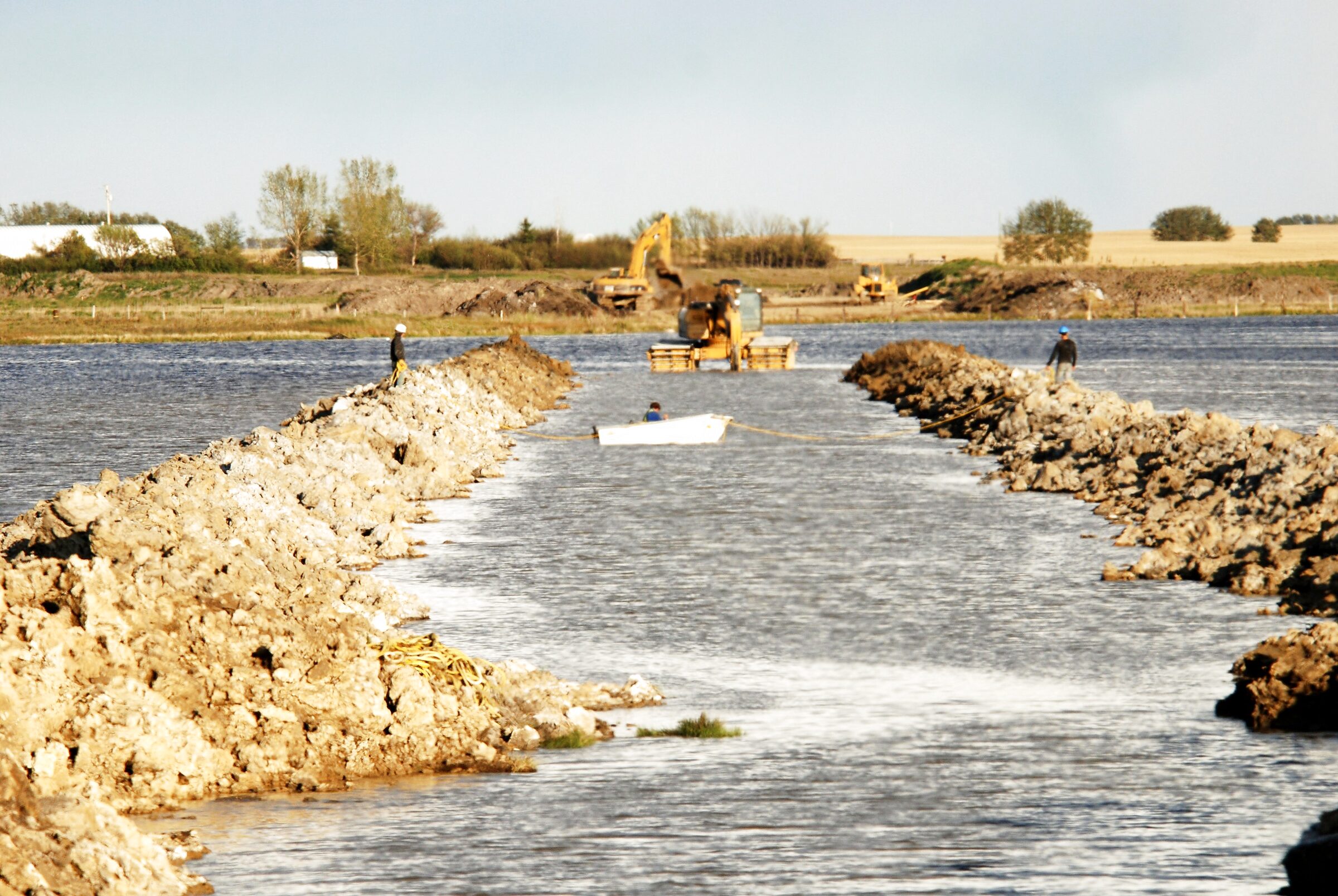
A rock berm running out through standing water, built up from the bed, with worked ground on the bank behind it.
Launch and recovery

In at the Launcher.
Out at the Receiver.


Handling mirrors industry-standard pipeline-pigging practice, because the fittings on a serviced line were built for exactly this operation and are standard hardware.

Step 1

In at the launcher

Inserted at a pig launcher or equivalent access point. The payload module is fitted and the mode selected: flow-driven if the line is live, self-propelled if it is not, tethered if the run needs a fixed speed and a hard stop on command.

Step 2

Riding the line

It rides on flow, under its own power or on the tether, carrying and sensing the length of the run. Data streams over fibre where a tether is fitted and logs onboard where it is not. The line stays in service throughout.

Step 3

Out at the receiver

Retrieved at a receiver or exit point, or pulled back on its tether. Logged data offloads at the receiver end, the way an inspection gauge has always come home.

The line itself is the hazard list, and every item on it is a known class with a known answer. Girth-weld root beads, mitred joints, unbarred tees where a cup can dive into a branch, reduced-port valves, dents and ovality, wax and scale and diameter transitions are met with bumper noses, disc spacing that always keeps two supports in the barrel, and a minimum-bore gauging run first. That last is a rule rather than an option, inherited from the group's operating practice: CS-460 never enters a line a gauge run has not been through first.

The defining risk in this trade is a stuck tool, sharpened by a payload aboard, and the answers are above: gauge run every time, locating every time, tether wherever retrievability is what the mission turns on.

Navigation and the record

Position Is One Number.
Nothing Radiates to Get It.


Underground, inside steel, RF is dead and GPS never existed. Pipe and conduit are RF-dead environments by nature, so the fleet's doctrine costs nothing to keep here.

Navigation is one-dimensional, and that is the good news: position is a single number, distance along the line. Spring-loaded odometer wheels count it, and running several and voting between them handles slip, wax films and wheel wear; in the self-propelled mode the drive wheels give odometry for nothing. Every girth weld is a ready-made milepost, and detecting each one re-zeros accumulated error, so drift is corrected against the pipe rather than left to grow. A small inertial unit adds attitude, bend detection and dead-reckoning through a slip. All of it is passive.

The comms plan follows the mode. Tethered, the fibre carries live video and live control. Flow-driven and self-propelled, it is record-and-return: the data comes out of the trap with the tool. Surface truth is a crew or above-ground markers confirming passage through the wall by passive magnetic detection, so nothing is emitted to find it. No radio link exists in any mode, and there is nothing to jam.

An untethered run executes a pre-planned mission script against odometry waypoints: travel, sense, act at a surveyed point, continue, be received. It is the narrowest autonomy in the fleet. The vehicle cannot roam, and a person authorizes every actuate event before insertion.

The payload bay

One Bay, Four Classes,
Every One of Them Non-Kinetic.


A modular bay sits amidships at ~8–15 kg and ~10 L. The interface is defined once, so a new payload is a tooling change rather than a redesign of the vehicle.

INSPECT

The baseline suite

Camera, laser profilometry, wall-thickness and corrosion gauging, leak and gas sensing, pressure and temperature logging, run odometry, geometry and deformation mapping.

EMPLACE

At a surveyed waypoint

Set down a seismic or acoustic node, a relay or a marker at a surveyed point, through a bay door and an ejector commanded at an odometry waypoint.

LAY FIBRE

From an onboard spool

Pay out optical fibre as the vehicle travels: the family's fibre-conduit product, restated through pipe that already exists.

TREAT

At a located defect

Discharge internal sealant, corrosion inhibitor or repair material at a defect the inspection run located: a tank, a pump and valve set, an applicator ring.

Mechanically the interface is a standard module length per bore size, a common chassis-ring bolt pattern and a common articulation coupling. Electrically it is one connector carrying regulated power, a data bus and a safety-interlocked actuate line. Defining it once turns four payload classes into one family.

Wall-thickness sensing is where a carrier should be exact about what it buys. Magnetic flux leakage is the industry workhorse, and its magnet and yoke mass is significant in the bay budget. Conventional ultrasonics need a liquid couplant, fine in a liquid line and a problem in gas. Electromagnetic transducers work without one. Canadian Shield builds the carrier and partners the sensing physics.

Doctrine
A carrier, never armed. The exclusion sits on the interface.

The bay volume and the actuate line are engineered for sensors, relays, fibre and service fluids. No warhead, no fuze, no energetic material and no terminal-effect device is a permitted payload class, in any variant, for any customer, and that is a design exclusion on the interface.

Fit and scope

Who Sends a Tool Down a Line
Nobody Should Walk.


One question here is not engineering at all. Whether a given line may be entered is a matter of ownership and permission, settled before any of the above matters.

The vehicle is indifferent to who owns the pipe. On line an operator owns or holds contracted access to, entry is a commercial fact and a permit to work; anywhere else it is a legal question first, and no engineering answer touches it. Human safety comes first, on every line, and it is why this platform exists: a live line is a confined space nobody should have to enter to learn what is wrong with it.

WHO IT IS FOR

Owners and operators of line already in the ground

  • A pipeline or utility operator with line nobody should have to enter on foot
  • A facility or plant engineer holding dead legs and conduit no crew can be sent into
  • A municipal operator working culverts and storm sewers already in the ground
  • An engineering officer needing a sensor, a relay or a fibre run carried through infrastructure that exists
  • A buyer weighing sovereign underground capability, moulded and cut on Canadian tooling
WHAT IT IS NOT

In every module, for every customer

  • Not a munition. No warhead, no fuze, no energetic material, no terminal-effect payload, in any module
  • Not in the spectrum. No radio and no GPS anywhere in the design, and no link in any mode
  • Not a borer. Making the hole belongs to the plant: CS-410 on the defence job, Aquifer CS-411 on the civil one
  • Not a pipeline-class crawler. Under its own power the battery bounds the run; long lines are flow-driven or tethered
  • Not an offer. Nothing on this page is an offer, and no price is quoted anywhere on this site
The conversation

The Bend Count Decides the Run.
Bring It First.


If you hold network in the ground and a job inside it, the conversation starts with the line and the fittings on it rather than with a machine.

Bring the bore class, the product in the line, the operating pressure, the bend count and the traps you have. The answer covers the vehicle, the disc set, the bay and the mode that suits the run. Enquiries are screened, counsel comes first on any international transfer, and permits are taken per shipment. Every design in the family is patent pending.

The Underground family is the whole set side by side. CS-410 and Aquifer CS-411 make the hole this one never touches, and who it is for is the buyer's view.

All Underground family designs are patent pending; international transfer is export-controlled and subject to Canadian government permits taken per shipment, and nothing on this page is an offer.